
Is There PFAS In My Drinking Water?
Summary
PFAS is a broader term for over 12,000 chemicals
PFAS can increase your risk of cancer and affect reproductive and developmental health
Certified granular activated carbon (NSF/ANSI 53 or NSF/ANSI 58), ion exchange, and reverse osmosis filters are all effective at removing PFAS
Specific water treatment companies and plumbers familiar with PFAS methods can help install these treatments
What is PFAS?
PFAS, which stands for per- and polyfluoroalkyl substances, are persistent chemicals found in the air, soil, water, food, personal care items, and cleaning products. It’s a broader term for over 12,000 chemicals. PFAS are often referenced as ‘forever chemicals,’ as they may take over 1,000 years to break down.
Where Do PFAS Come From?
PFAS are produced and used in factories and products. When PFAS-containing products are thrown away in landfills, they can enter the atmosphere and soil. Once in the atmosphere and soil, the chemicals can travel even further, contaminating our environment.
Because PFAS are present in our atmosphere, they’re also found in rainwater. This means that when it rains, it may also deposit PFAS into lakes, rivers, and oceans. Depending on your water source, PFAS may be present in your drinking water.
Are PFAS Microplastics?
Although people use microplastics and PFAS interchangeably, they are very different. Microplastics refer to microscopic pieces of plastics that originated from larger deteriorating plastic.
PFAS, on the other hand, are chemical compounds used in a variety of products. PFAS can be used as coating on plastics, which means that some microplastics may have traces of PFAS on them.
Health Effects
Exposure to PFAS can put you at higher risk for certain cancers, such as testicular, kidney and prostate cancer. It may also lower your body's immune system response and reduce effectiveness of vaccines.
The effects of PFAS are a concern for children and pregnant women. PFAS can affect reproductive health as well as cause developmental delays or issues in children.
How To Treat PFAS
Although PFAS are a concern across the globe, scientists have found methods to effectively remove PFAS from drinking water. The three most common methods are granular activated carbon filtration, ion exchange treatment, and reverse osmosis.
Granular Activated Carbon FIlter (GAC)
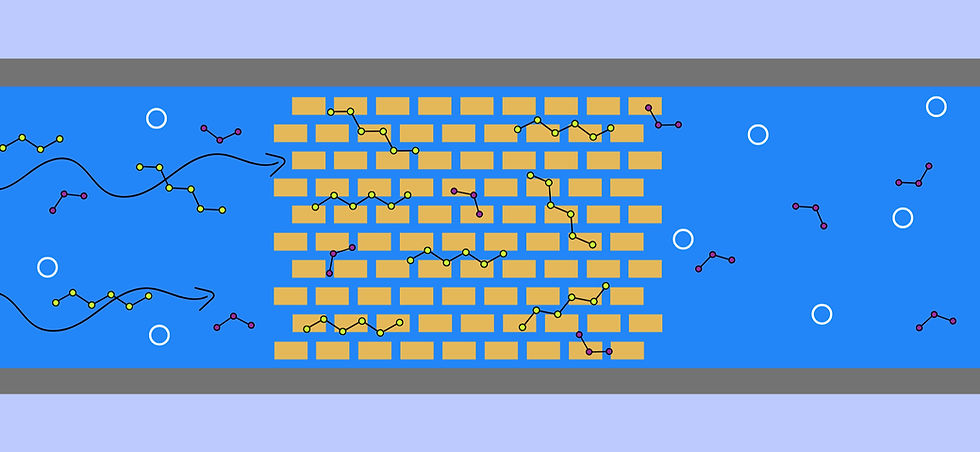
This is an example of Granular Activated Carbon. Notice how it captures/traps the long chain PFAS, but shorter PFAS can slip through!
Granular activated carbon filters, or GAC for short, trap PFAS chains as the water passes through. This makes GAC highly effective at removing PFAS chemicals with longer chains, whereas smaller PFAS chemicals may slip through.
GACs can be installed either at point-of-entry (filters your water before it enters your home) or point-of-use (filters water before it exits a specific faucet).
Because GACs will trap and accumulate PFAS as time goes on, they will need to be replaced to ensure proper filtration. The frequency of replacing your filter is based on contamination and water use levels; the higher use and more contaminants in your water will require you to replace your filter more often.
Ion Exchange
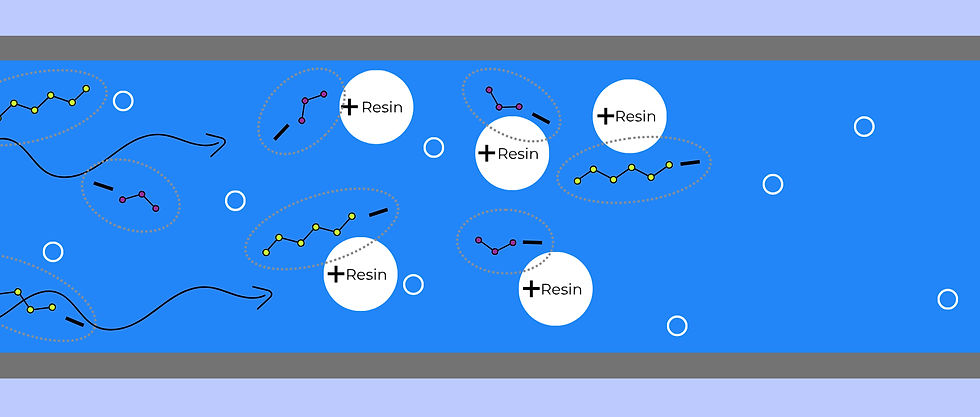
This is an example of ion exchange. The positively charged resin beads attract and hold onto the negatively charged PFAS molecules. Both short and long chain molecules are trapped.
Ion exchange treatments utilize positively charged porous resin beads that attract negatively charged PFAS molecules. When the PFAS attaches to the resin beads, it prevents them from entering your drinking water. Ion exchange is able to filter out long and short chained PFAS.
Ion Exchange treatments are typically installed as point-of-entry systems, but they can also be installed as point-of-use depending on the treatment you buy.
Like GAC, the resin will need to be replaced over time based on usage and contaminant levels.
Reverse Osmosis

This is an example of Reverse Osmosis. The semi permeable membrane prevents short and long chain PFAS from entering your drinking water.
Reverse osmosis is another method for filtering water. It uses a semi-permeable membrane to filter out the PFAS. The membrane allows water to pass through without any other contaminants. RO filters are able to filter out long and short chained PFAS.
Reverse osmosis is recommended for point-of-use because it can be costly to use it for your entire home. RO filters out almost everything, the good and the bad. This means that your water may not have all the minerals, which could lead to a ‘flat’ taste. If this is a concern, water can be easily remineralized using drops or filters.
It’s recommended to change RO filters at least once a year.
Which Treatment is Right for You?
All three of these treatments have been proven to be effective at removing PFAS from drinking water. However, there are some differences between each method. See table blow. For more information on what treatment system works best for you we recommend talking to a local water treatment company.
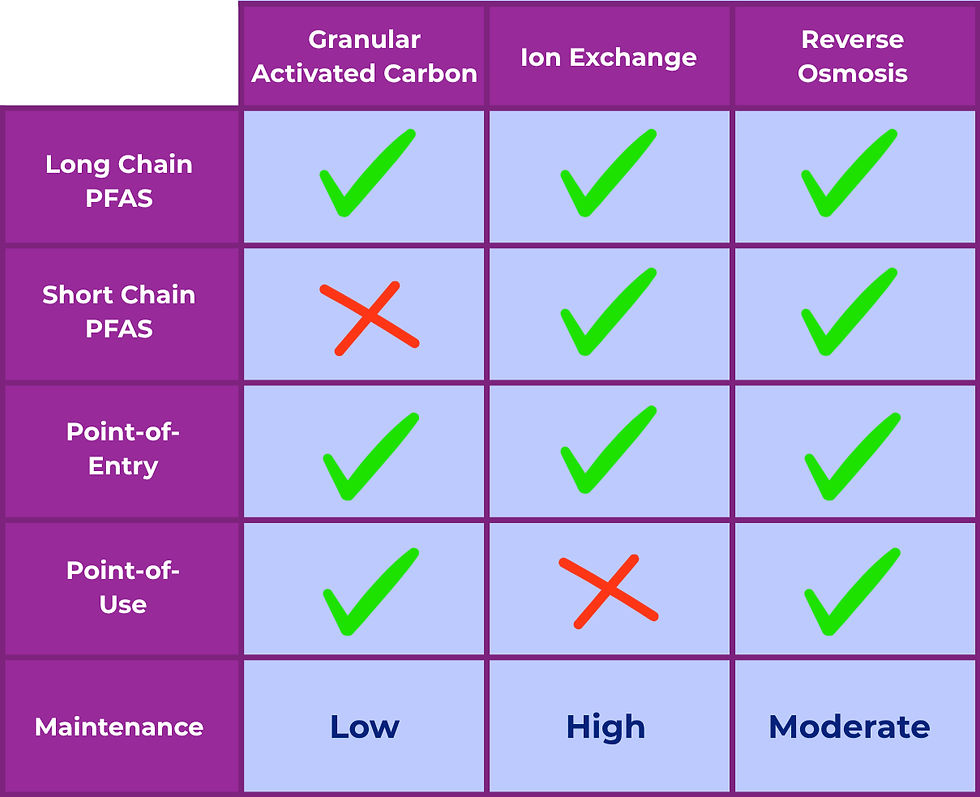
Once you’ve decided which method to use, make sure that the specific product you buy is NSF/ANSI 53 or NSF/ANSI 58 certified. These certifications ensure that the products effectively remove PFOS, PFOAS, or seven different PFAS compounds (including PFOS and PFOAS).
It’s also common to use a combination of these methods. RO systems are typically used in tandem with ion exchange.
Testing For PFAS
Testing for PFAS in drinking water is fairly new and highly costly, therefore few labs are MDH certified. Labs that do test for PFAS don’t test for all 12,000 chemicals, instead they test for specific PFAS chemicals that are the most common.
There are two labs in MN that are certified to test for PFAS according to their current database:
Minnesota Valley Testing Laboratories, Inc.
Located in 1126 N Front St, New Ulm, MN 56073
Pace Analytical
Located in 1700 Elm Street SE, Minneapolis, MN 55414-2485
Who Should You Contact For Help?
Most water treatment companies can sell and install these filters for you at an additional cost. Plumbers can also install any filters you purchase. It’s also important to make sure the filter you buy is high quality and suitable for filtering out PFAS.
If your home is located in one of the East Metro communities affected by the 3M PFAS settlement, you’re entitled for free PFAS testing through the MDH. If the tests are positive, you will be connected to city water and reimbursed for any fees and costs. However, if you’re unable to connect to city water you will be given a GAC that is paid for and maintained by MPCA.
References
https://pbswisconsin.org/news-item/what-should-i-do-about-pfas-in-my-water/
https://www.health.state.mn.us/communities/environment/hazardous/topics/pfashometreat.html
https://mytapscore.com/blogs/tips-for-taps/the-ultimate-guide-to-pfas#section8
https://www.fox9.com/news/pfas-contamination-spreads-twin-cities-east-metro-hundreds-wells-flagged
https://www.pca.state.mn.us/sites/default/files/wq-gw1-09.pdf
https://www.theguardian.com/environment/2024/nov/25/pfas-microplastics-toxic


Comments