
How Does Arsenic Enter Drinking Water?
Summary
Arsenic exposure can increase cancer risk, raise infant mortality, and harm cognitive development
Arsenic can enter your water through natural sources, like weathering rocks, and human activity
Reverse osmosis, anion exchange, and activated alumina are all effective ways of removing arsenic from drinking water
Plumbers and water treatment companies can help you install any filters you may need
What is Arsenic?
Arsenic is a heavy metal that can cause adverse health effects with long-term exposure. Arsenic is a carcinogen, specifically for the skin, bladder, and lungs. It can cause skin lesions like pigmentation changes, keratosis, and hard patches. Arsenic is especially dangerous for pregnant women and young children. Arsenic has been proven to increase infant mortality and affect cognitive development.
Arsenic (III) vs. Arsenic (V)
There are two forms of arsenic that can be found in your water, As (III) (also known as arsenite) and As (V) (arsenate). As (III) is more toxic than As (V), however As (V) is still toxic and a health concern. As (III) is typically harder to remove with most filters because it's often found in a neutral state.
How Does Arsenic Enter My Water?
Arsenic naturally occurs in the environment, but can enter our waterways in many different ways.
Natural Sources
Originally, arsenic was deposited across Minnesota by glaciers in the form of rocks and sediment. Now, arsenic is released into our groundwater and waterways by those same rocks and soil.

The arsenic naturally found in rocks can leech into the surrounding soil and groundwater. This can eventually end up in our drinking water.
The concentrations of arsenic vary throughout the state. More specifically, Western Minnesota and the Western Metro tend to have higher concentrations of arsenic due to glacial deposits.
This map depicts areas in MN with water exceeding the MDH maximum contaminant level, 10 mg/L.
Map sourced from Minnesota Department of Health at https://www.health.state.mn.us/communities/environment/water/wells/waterquality/arsenic.html
Human Sources
Humans can also release arsenic into our waterways. Arsenic is heavily used in many products like animal feed, pesticides, wood preservatives, and glass. These industrial manufacturing processes and products can release arsenic into our natural environment.
Mining accelerates the weathering of rocks, which also accelerates the release of arsenic into the groundwater.
How Can I Remove Arsenic?
There are a few common methods used to remove arsenic from your drinking water:
Reverse Osmosis

This is an example of an RO filter. Notice how the RO removes ALL contaminants from your water, not just arsenic.
Reverse osmosis (RO) systems utilize a semi-permeable membrane to stop arsenic from entering your faucet. A semi-permeable membrane only allows water through while stopping other contaminants. This means that RO systems remove most contaminants, but also beneficial minerals.
RO systems may require pre-treatment filters to remove any large debris from your water. RO water may have a ‘flat’ taste due to the absence of minerals so post-treatment filters can provide you with your preferred aesthetics by adding minerals back into your water. RO filters are highly effective at removing arsenic, especially As (V). It is still able to remove As (III), but not as effectively. To ensure all As (III) is removed, a pre-treatment filter may be installed.
RO systems require fairly low maintenance. Most RO systems should have their semi-permeable membrane replaced every 2-5, and any additional filters replaced every 6 months.
Anion Exchange

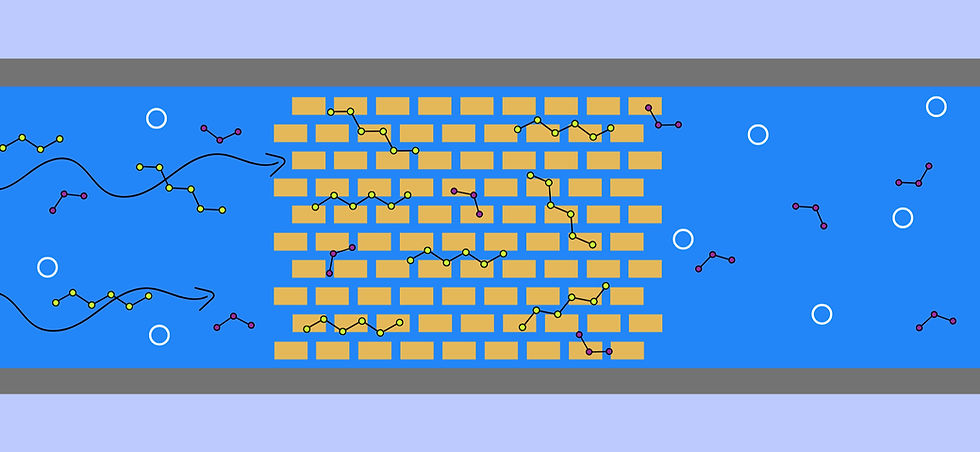
This is an example of anion exchange. Notice how the resin only holds onto the arsenic, but other contaminants go through.
Anion exchange units use positively charged resin to capture and trap the negatively charged arsenic. Unlike an RO system, anion exchange units only remove compounds with a negative charge (anions). This means that other positively charged compounds will still remain in your water. Like the name suggests, the resin will hold onto the arsenic and then exchange it with chlorine. These chlorine levels are not significant to your health, but may change the taste.
There are two forms of arsenic, As (III) and As (V). Anion exchange systems are effective at removing As (V). Unlike RO, anion exchange systems are not able to remove an As (III), so pre-oxidation treatments must be used to remove As (III).
Anion exchange systems can require frequent maintenance depending on how contaminated your water is. Because they trap the arsenic, overtime they will become filled up and unable to remove any more contaminants.
Activated Alumina

This is an example of activated alumina. The alumina granules trap the arsenic, but other contaminants are still able to pass through.
Activated alumina essentially traps and holds onto chemicals. Activated alumina is especially good at filtering out heavy metals, like arsenic. When your water passes through the activated alumina, the contaminants attach to the surface of the aluminum oxide granules
Like RO, activated alumina may need pre-treatment filters. Removal of arsenic from activated alumina is pH dependent, so pre-treatment filters can ensure your water is in the adequate pH range of 5.5-6. If your water is not within the range, arsenic removal can drop by 15%. Activated alumina removes As (V), but may not always remove As (III) as reliably. Pre-treatment filters can be used to ensure removal.
Similar to anion exchange, activated alumina will require replacement depending on water usage and level of contaminants.
What Option is Best For My Home?
All three options are effective at removing arsenic from your drinking water, but there are some differences in maintenance, cost, and the types of additional treatments you may need:
Who Should I Contact For Help?
To test if you have arsenic in your water, you can contact one of the many MDH accredited labs using the MDH database.
You can buy filters to remove arsenic from most water treatment companies. They can install these filters for you as well for an additional cost. Plumbers can also install any filters for you.
References
https://www.usgs.gov/mission-areas/water-resources/science/arsenic-and-drinking-water
https://www.health.state.mn.us/communities/environment/water/wells/waterquality/arsenic.html
https://www.smenet.org/What-We-Do/Technical-Briefings/The-Role-of-Arsenic-in-the-Mining-Industry
https://www.epa.gov/sites/default/files/2015-09/documents/train5-mitigation.pdf
https://drinking-water.extension.org/drinking-water-treatment-activated-alumina/
https://www.axeonwater.com/blog/reverse-osmosis-vs-ion-exchange/


Comments